Garage Doors
What the noises mean
Knowing a little about your door makes you a better judge of the advice you get. That is why we publish these guides: so the decisions are yours, made with the facts in hand.
Short answers
Is the inspection a repair visit?
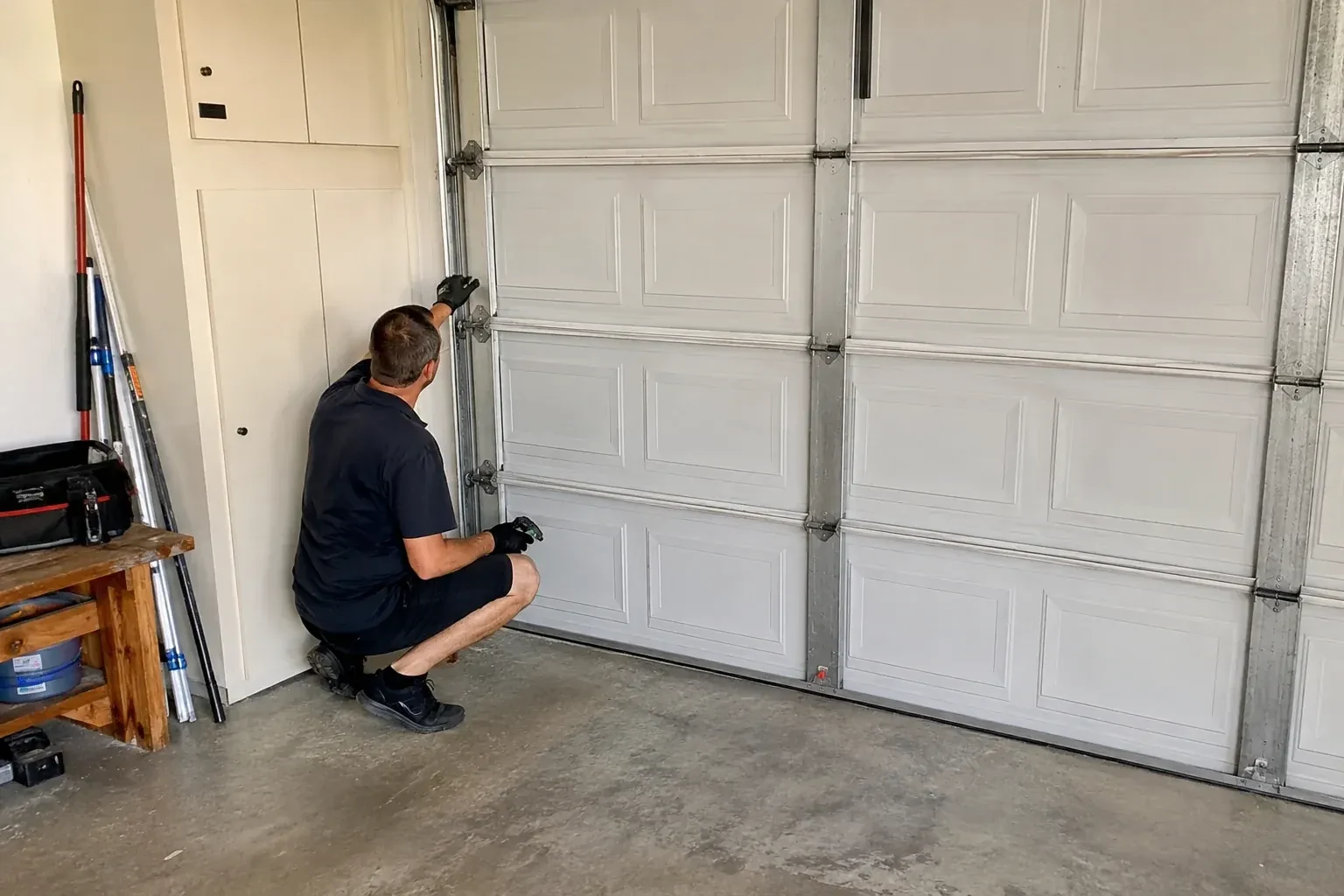
It is a look and a record first. Small maintenance items such as lubrication, cleaning and aligning the photo eyes and tightening fasteners can be done on the spot if you wish. Anything involving spring tension, cables, drums, worn rollers or damaged sections is written up with a clear explanation and quoted as its own job, so you decide with the full picture in front of you.
How often should a garage door be tuned up?
Once a year suits most attached garages here, ideally in the fall before cold weather thickens lubricant and stiffens seals. Door and opener makers suggest lubrication every three to six months and a homeowner balance check and reversal test every month, so an annual professional visit sits on top of that light routine. A lightly used door in a detached garage may go longer; a heavily used one, or one exposed to salt spray, benefits from a spring check too.
I only tapped the door with the bumper. Why is it off its track?
A sectional door is strong in the direction it travels and surprisingly easy to push sideways at a single roller. A light nudge on the bottom section can flex the track lip enough for the roller to slip out, after which the section twists and the rollers above follow. The good news is that this kind of event usually leaves the cables and springs alone, so the reset is often rollers, a re-formed track lip and a hinge check.
Will the new section match the colour of the rest of the door?
It will match the factory colour your door was made in, which is not quite the colour your door is today, because paint fades in sun and weather. A fresh section can look noticeably brighter than its neighbours, and that difference may not go away with time. If the contrast bothers you, the whole door can be painted with an exterior product suited to the finish. Ask to see the current colour chip against your door first.
How do I look after the new seal?
Wipe it clean of salt and grit a few times a year, and give it a light coat of silicone spray each autumn so meltwater has nothing to bond to. Keep petroleum products and solvents away from it, since they soften vinyl. Clear ice and packed snow from the threshold before running the door in winter. Once a season, look under the closed door for daylight. That is the whole routine.
My door was replaced last year. Does the perimeter seal need doing too?
Often, yes. A new door is sometimes fitted against the original wood stop and its old fin, and the new door may sit slightly differently in the opening, so the old seal no longer meets it. If daylight shows at the edges or the fin is hard and cracked, a new seal set against the new door completes the installation and matches the fresh look of the door.
The wood around my lock is soft. Can it still be repaired?
Yes. The decayed wood is cut back to sound material and a hardwood block or a steel backing plate is let in behind the handle and along the stile where the bar guides sit. The handle, mechanism and guides are then fixed to that new material with through-bolts rather than screws into soft grain, so the lock turns without rocking and the bars hold their line.
What is checked after the rollers go in?
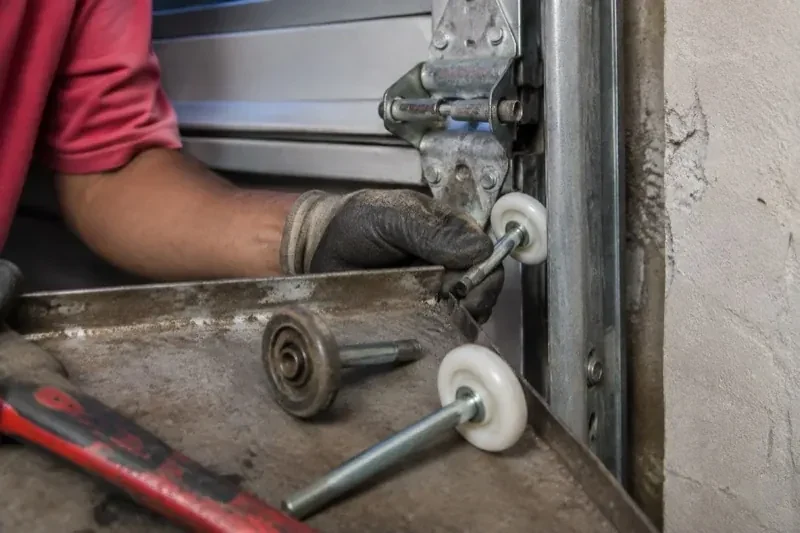
The door is run through several cycles with the technician watching each wheel stay seated, then balanced by hand with the opener released to confirm it holds at halfway. The top section is checked for a tight seal at the header, the hinge and bracket fasteners are snugged, and the opener's force and reversal are tested with a 1-1/2 inch block in the door's path. The industry checklist for a residential door covers exactly these points, and they are all part of finishing the job.
What is the difference between an edge hinge and a centre hinge?
An edge hinge sits at the end of the joint on the end stile and does two jobs: it links the panels and it holds the roller that runs in the track, which is why it is numbered for its position. A centre hinge sits on an intermediate stile in the middle of the door, links the panels only, and carries no roller. Both let the panels pivot as the door folds around the curve.
Does a heavy insulated door need heavier track?
Usually the standard two-inch track handles a residential insulated door well, provided the gauge matches what the door maker specified and the brackets and hangers are properly fixed. Very heavy or oversized doors, and some carriage-style wood doors, are set up on three-inch track or on heavier-gauge two-inch. If a heavier door was hung on the light track from an earlier door, flexing and spreading follow, and the technician will say so.
Can I use the door as soon as the work is finished?
Yes. The visit ends with the door balanced by hand, run through full cycles and the opener reconnected and tested, so it is ready for normal use the moment the technician packs up. There is no settling period for cables. It is a good idea to watch the first few openings yourself to get a sense of how a level, balanced door sounds, so you notice any change later.
What about a garage with very little space above the door?
Low-headroom garages use a different arrangement: the spring assembly may be mounted at the rear of the horizontal tracks, or special low-headroom drums and track bring the door up with less clearance. Replacement follows the same principles, but the drums, cable routing and turn count differ. The technician identifies the system on arrival and brings hardware that suits it, so the door balances correctly in the space available.
The door creeps open on its own. Is that a spring problem?
Usually, yes. A door that rises from the floor or from halfway without help has springs pulling harder than the door weighs, which happens when a heavier-rated pair was fitted, when the hooks were set with too much stretch, or when a door has been made lighter by a panel change. It also puts strain on the opener, which has to hold the door down. Weighing the door and fitting the correct rating, set evenly, settles it.
Will I need new springs, or just an adjustment?
The inspection decides, and looks past appearance alone. A spring can look sound, with tight, evenly spaced coils, no rust pitting and no gap, and still be the wrong specification for the door or nearing the end of its service life. The technician checks the spring's specification against the door's weight and history: a spring that checks out is wound and left in service, while one that is undersized, stretched, corroded or close to its cycle life is better replaced. Either path ends in a balanced door.
My opener has no photo eyes. Can it be kept in service?
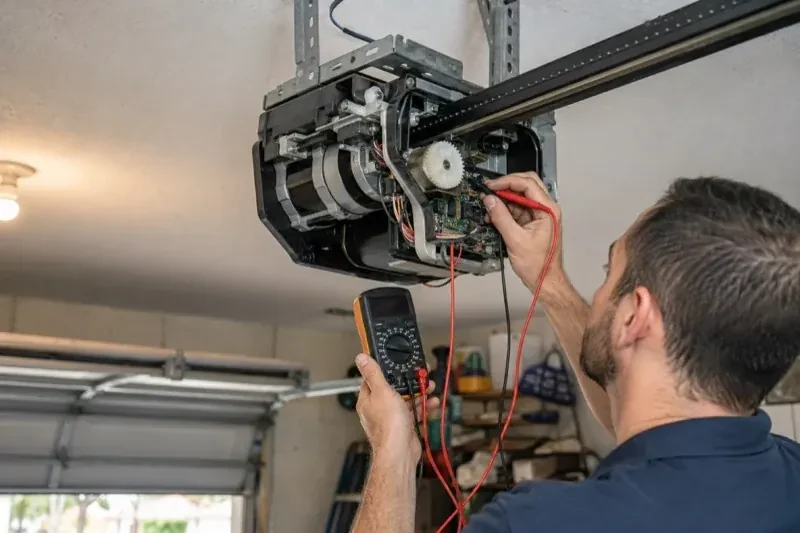
Openers without an external sensor date from before 1993, when photo eyes or an equivalent device became part of the operator standard. The door industry's own inspection checklist and consumer safety regulators both recommend replacing such units rather than repairing them, because the contact-reversal feature alone is a weaker protection for anyone or anything under the door. A diagnosis on one of these units usually ends with a replacement recommendation, explained plainly.
Should I oil the chain?
Follow the opener's manual, and lean toward less. Many makers ask for the chain to be left dry or given only a very light treatment, because a heavily oiled chain collects grit that grinds the sprocket and drips onto the car. The grease that matters is white lithium on the rail where the trolley runs, renewed every two or three years, and on the gears inside the head, which the technician packs during a repair. Penetrating sprays are kept away from the whole drive.
Is a belt drive harder to repair than a chain drive?
No, just different. The belt is lighter, runs dry and is replaced as one length with a clip, where a chain has links and takes grease. The tensioning at the trolley works the same way on both, and the sprocket, idler and trolley are similar parts. What a belt drive rewards is care with tension and a straight rail, because it is chosen for quiet and shows any fault as noise.
Can I keep my existing wall button?
The new operator comes with its own console, and the two usually go together because the console is designed to speak to that board and adds a light button, a lock button and sometimes a timer or a battery indicator. The low-voltage wire running to the old button can often be reused if it is in good condition, which saves running a new line across the garage.
Do both sensors get replaced together?
Yes. The sending and receiving sensors are made and sold as a matched pair for a given opener family, and the head unit expects both to be from the same generation. Fitting a pair also means both lenses, both indicators and both mounting points are fresh at the same time, so the alignment holds and the next check is simpler. A single sensor from an unrelated kit is where mystery faults come from.
Does programming a new remote erase the old ones?
No. A short press of the learn button adds a control to the memory alongside the others. Erasing them takes that model's own sequence, a longer hold on many openers and a different button combination on others. Pressing into the erase sequence by accident is what occasionally leaves a household finding every remote dead after trying to add one. The fix is to reprogram each device.
Why does the door beep and flash before it closes from the app?
Because someone closing a door they cannot see needs to give anyone near it a warning. The operator standard for garage door openers requires an audible alarm and a flashing light for several seconds before a door moves on an unattended command, along with working photo eyes. The beeper and light are built into the controller for that reason, and they are tested during setup so you have heard them yourself.
How long does an emergency release repair take?
A cord and handle, a lever spring or a trolley freed from the stop bolt is a modest part of an hour, including the balance test and reversal tests. Replacing a trolley or fitting an outside key release takes longer, since the drive is slackened and re-tensioned or a hole is cut in the door. If the balance test finds the springs need work first, that is a separate piece of the visit, and you are told before it starts.
How is installation timing planned?
Timing is set after the door specification, site preparation, access and delivered components are confirmed. A straightforward opening and a project needing framing, electrical coordination or unusual track geometry have different sequences. The proposal should identify prerequisites and installation scope so the visit is scheduled around a ready opening and a verified door package.
What safety checks are done after installation?
The installer first checks manual balance, cable tracking, roller travel, track supports, fasteners and the fully open and closed positions. If an operator is connected, complete powered cycles follow. Photo-eye response, contact reversal according to the operator instructions, wall controls and emergency release are demonstrated. The customer also receives guidance on safe gripping points and keeping clear of section joints.
What should I watch for during strong winds?
During strong or severe winds, shelter in a basement or small interior room away from windows, doors and exterior walls, rather than watching the door while it blows. Once conditions have passed, look over the opening: note unusual bowing, new creases, displaced rollers, loose attachments, perimeter gaps, or movement at brackets and jambs, and let these details guide a later assessment.
How should I prepare the garage before installation?
Move vehicles outside and clear stored items from the door, side tracks, ceiling path and opener area. Provide access to wall controls and the electrical receptacle, and protect belongings that are sensitive to normal installation dust. Exterior access in front of the opening should also be open. Mention alarms, interior finishes or fragile landscaping that affect how the work area is arranged.
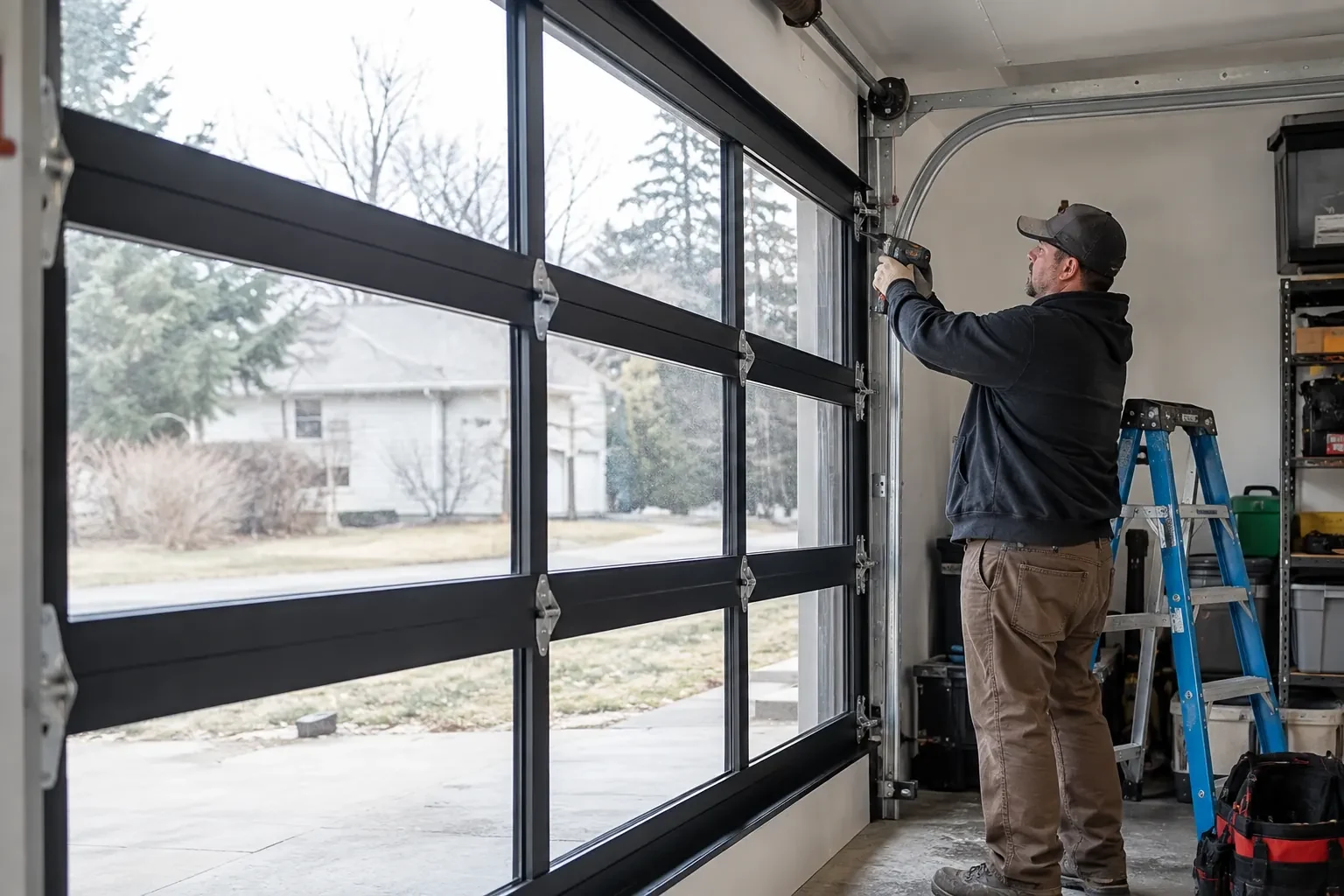
Can a full-view door fit a low ceiling?
A low ceiling may suit a low-headroom track arrangement, but the decision depends on measured space above and behind the opening. Beams, bulkheads, lights, ducts, storage and opener hardware are mapped together. The selected sections also need the correct top-fixture geometry and travel path, so feasibility is established from the complete room rather than ceiling height alone.
Can the finished door still be operated manually?
Yes. A properly counterbalanced sectional door is checked by hand, whether or not an electric operator is added. With powered equipment, a manual release disconnects the operator so the designated handle can be used; the door is closed first, since an open or unbalanced door can move unexpectedly once released. Handover includes a demonstration of disconnection, movement and reconnection under the product instructions. The release path and lifting area should remain accessible rather than being blocked by storage.
How are springs and cables handled during repair?
The technician first controls the door's weight and position with suitable supports or clamps. Stored spring energy is then managed with proper winding tools and a defined sequence before connected parts are loosened. Cables, drums and springs are matched to the door and lift geometry, installed with the system secured, and checked for level tension through controlled movement.
When is operator replacement considered?
A broader operator plan may be considered when major drive or control parts are extensively worn, suitable components are no longer supported, the unit is mismatched to the door or duty, or the desired control arrangement requires a different system. The door's balance, size, cycle pattern, protection devices, power and manual operation all inform that decision.
Does cold weather affect a high-lift system?
Cold, moisture and road salt can influence metal surfaces, seals and lubrication just as they do on other garage doors. The taller track path also makes unobstructed movement and correct cable winding important to observe. Follow the installed door and opener manuals for seasonal care, keep lower hardware clean, and arrange service when movement or sound changes noticeably.